


Summary
Vanderbilt researchers have developed a novel approach to enhance recombinant protein production in mammalian cell culture systems through metabolic engineering. By overexpressing specific metabolic proteins in these cells, this technology achieves higher monoclonal antibody titers and increased cell-specific productivity compared to conventional expression systems.
Addressed Need
Biopharmaceutical manufacturing faces significant challenges, with high operational costs, limited recombinant protein production efficiency, and suboptimal yields affecting drug affordability and availability. Vanderbilt researchers have developed a transformative solution for engineering Chinese hamster ovary (CHO) cell lines and other mammalian cells to maximize the yield and efficiency of recombinant protein production. These modified host cells demonstrate remarkable improvements, achieving enhanced recombinant protein yields and increased cell-specific productivity in preliminary testing. This breakthrough technology offers biopharmaceutical manufacturers a powerful new platform for therapeutic protein production with potential for significant cost reduction in manufacturing processes.
Key Benefits
- Increases protein yield without expanding facility footprint or equipment investment
- Reduces production costs through improved cellular efficiency and productivity
- Compatible with existing mammalian expression platforms for straightforward implementation
- Enhances metabolic performance without compromising product quality
Technology Features
- Engineered cell lines with stable overexpression of key metabolic proteins for superior performance
- Metabolically optimized cellular pathways that enhance energy efficiency and productivity
- Demonstrated increase in monoclonal antibody production titers
- Scalable approach suitable for industrial biopharmaceutical applications
Other Details
Intellectual Property Status:
Provisional patent filed.
Stage of Development:
Proof-of-concept demonstrated with engineered CHO cell line showing enhanced monoclonal antibody production and validated through growth and productivity analyses.
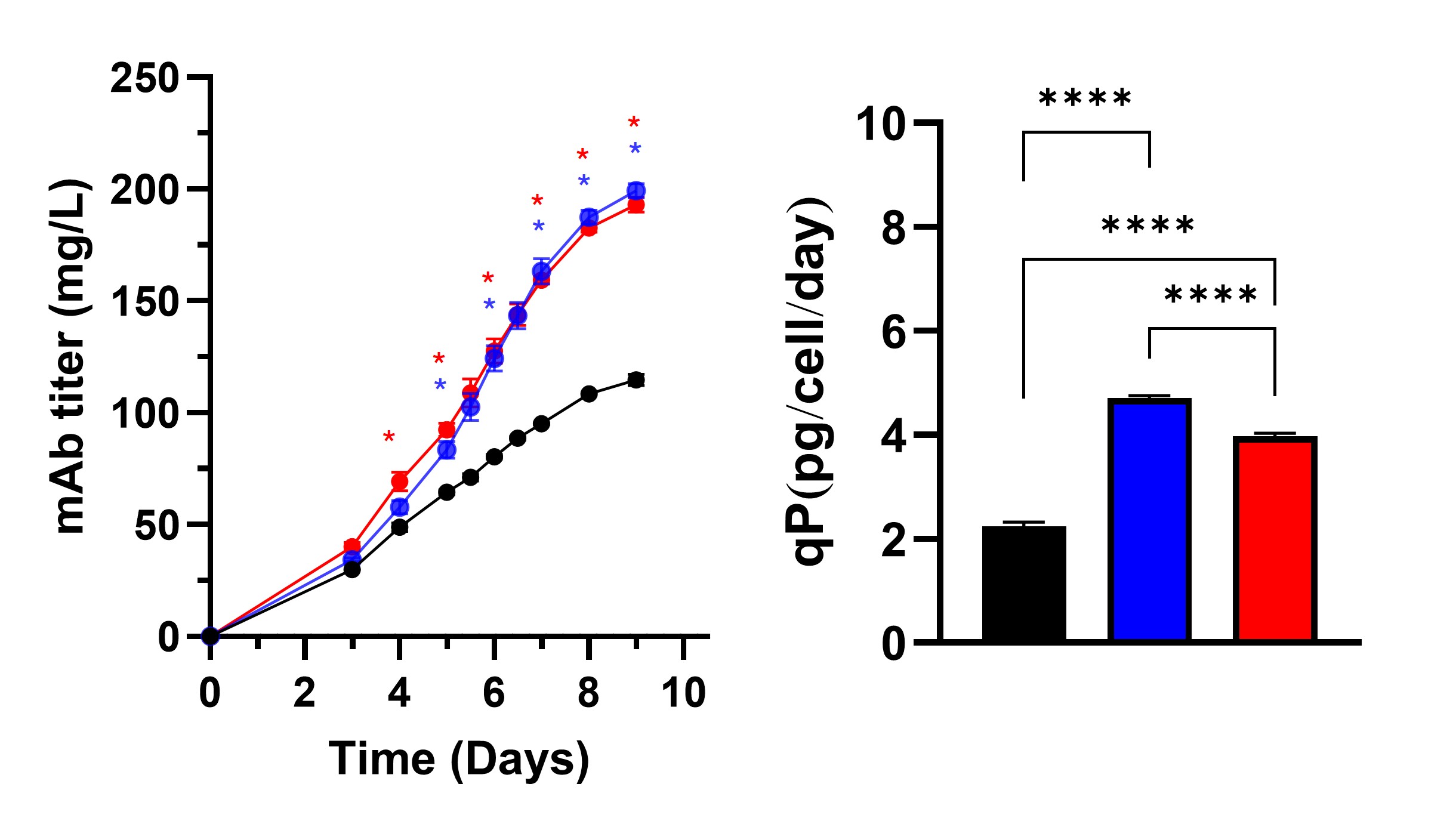
Comparison of parent CHO cells (black) to metabolically-engineered CHO cells (blue, red), showing approximately two-fold improvement in monoclonal antibody titers (left) and cell-specific productivity (qP) (right).